
Complaint Handling Procedure
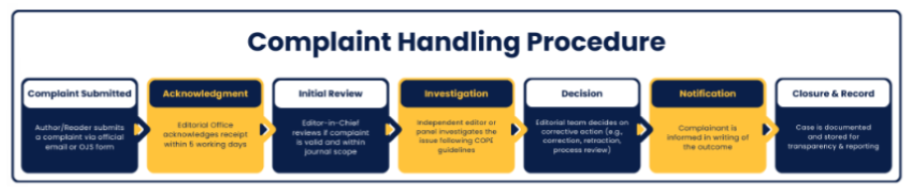
Journal of Scientia Technologiae (JST), published by Publisher Karya Grafindo Prima Perkasa, is committed to maintaining the highest standards of publication ethics, editorial transparency, and academic integrity.
The journal provides a formal procedure for handling complaints, appeals, and ethical concerns related to editorial decisions, peer-review processes, publication ethics, and scholarly publishing practices.
Scope of Complaints
Complaints may be submitted by authors, reviewers, editors, readers, or other stakeholders regarding:
- Editorial decisions or peer-review processes
• Allegations of publication misconduct, including plagiarism, data fabrication, falsification, or authorship disputes
• Errors, inaccuracies, or ethical concerns in published articles
• Violations of journal policies or publication ethics standards
• Breaches of good scholarly publishing practices
Submission of Complaints
Complaints must be submitted formally in writing through the journal’s official editorial communication channel.
The complaint submission should include:
- Full name and contact information of the complainant (unless anonymity is requested)
• Manuscript ID, article DOI, or other relevant reference information
• A clear explanation of the complaint
• Supporting evidence or documentation where available
• The complainant’s relationship to the journal or article (author, reviewer, reader, editor, etc.)
Suggested subject format:
Complaint – Manuscript ID / Article DOI
Acknowledgment and Initial Review
- The Editorial Office will acknowledge receipt of the complaint within a reasonable timeframe.
• The complaint will undergo an initial assessment to determine whether it falls within the journal’s scope, whether sufficient evidence is provided, and whether a formal investigation is required.
Investigation and Decision
If further investigation is necessary, the case will be handled by an independent editor or panel not involved in the original editorial process.
The journal may request additional information from:
- Authors
• Reviewers
• Editors
• Institutions or affiliated organizations
Investigations will follow COPE ethical guidelines and procedures where applicable. The journal aims to resolve complaints within a reasonable timeframe, although complex cases may require additional time.
Outcome and Communication
The complainant will be informed in writing regarding:
- The outcome of the investigation
• Editorial decisions or corrective actions taken
• Any publication amendments where applicable
Corrective actions may include:
- Manuscript revision requests
• Publication of corrections or errata
• Expressions of concern
• Retractions
• Changes to editorial or review procedures
Confidentiality will be maintained throughout the process unless disclosure is legally required or necessary for institutional investigation.
Appeals and Escalation
If the complainant is dissatisfied, they may request further review by a senior editorial board member or the Publisher, Publisher Karya Grafindo Prima Perkasa.
If the matter remains unresolved, parties may seek guidance or mediation through COPE (Committee on Publication Ethics).
Record-Keeping and Transparency
The journal maintains confidential records of all complaints and resolutions.
Summary statistics of complaints and editorial actions may be included in journal reports or transparency statements to support accountability.
All procedures are conducted in accordance with international publication ethics standards and principles of fair, objective, and responsible scholarly publishing.